Preparing Infant Formula: Common Mistakes to Avoid
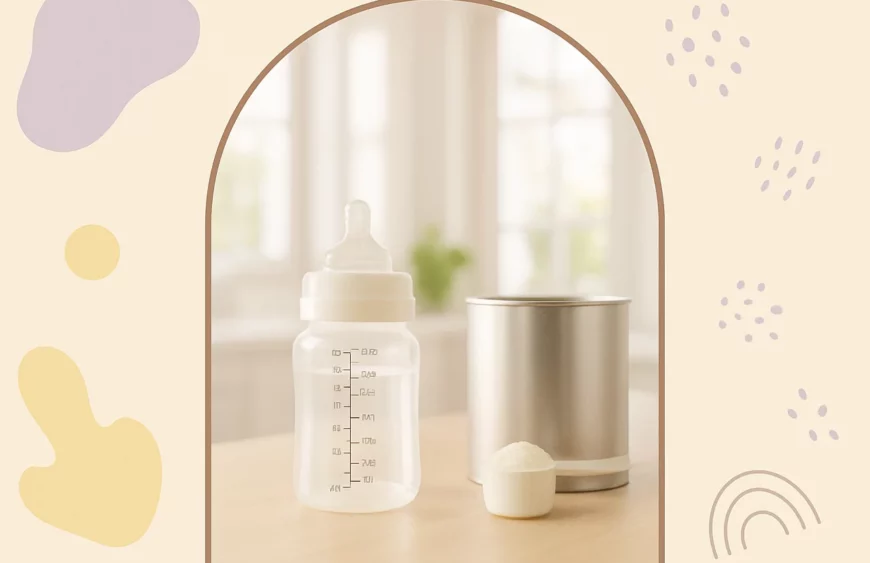
This image was generated using AI.
Making up a bottle feels like routine after a few weeks. That is exactly when the small inaccuracies appear: a heaped scoop, water measured by eye, the scoop from the old tin. We go through the typical trouble spots and show you how to avoid them in everyday life.
- The ratio of water to powder decides how many nutrients end up in the bottle.
- Always pour in the measured water first, then add the powder.
- Every scoop belongs only to the tin it came in.
- If you make a measuring error, throw the bottle away and start again rather than trying to correct it.
- Ready to feed formula milk takes measuring out of the equation entirely.
Why the mixing ratio has to be so precise
Infant formula and follow-on formula are composed so that the finished bottle reaches a specific composition. That calculation only works if water and powder come together in the ratio given on the tin. Breast milk does not need this step, it is ready to drink, and this is where bottle feeding carries extra responsibility.
Too much water dilutes the feed, so your baby gets less energy and fewer nutrients per bottle. Too little water makes the mixture denser than intended and puts a strain on your baby’s fluid balance. Neither is noticeable in a single bottle, but over weeks it adds up.
Which water mistakes happen most often?
Most commonly the water is estimated rather than measured, or it goes into the bottle after the powder. Both shift the ratio, because the powder itself takes up volume and the scale on the bottle no longer reads correctly.
So always pour in the measured amount of water first and add the powder afterwards. Read the scale at eye level, not at an angle from above. At night it helps to have bottles with clearly readable markings ready, so you are not guessing in the half dark.
Water temperature matters too. Water that is too hot can affect sensitive ingredients, while water that is too cool dissolves the powder less well. Lumps mean you shake for longer and harder, which works more air into the bottle. Stick to the manufacturer’s instructions on the tin.
Which water is suitable for the bottle?
Use water that is labelled as suitable for preparing infant formula, or tap water if it is approved for this purpose in your area. Unfiltered mineral water, untested well water or heavily mineralised water are not intended for this.
If you are unsure which water is suitable where you live, ask your paediatrician or your local health authority. Water quality varies from region to region, so there is no blanket answer.
Discover our organic baby food
The typical mistakes with the powder
With powder, small details decide the outcome. A heaped scoop looks harmless but changes the mixture measurably, and across several bottles a day it adds up.
- Pressing it down: Pressing powder into the scoop or tapping the scoop gets more in than intended.
- Wrong scoop: Every brand, and in some cases every stage, has its own scoop. A scoop from another tin or a teaspoon from the kitchen drawer will not match.
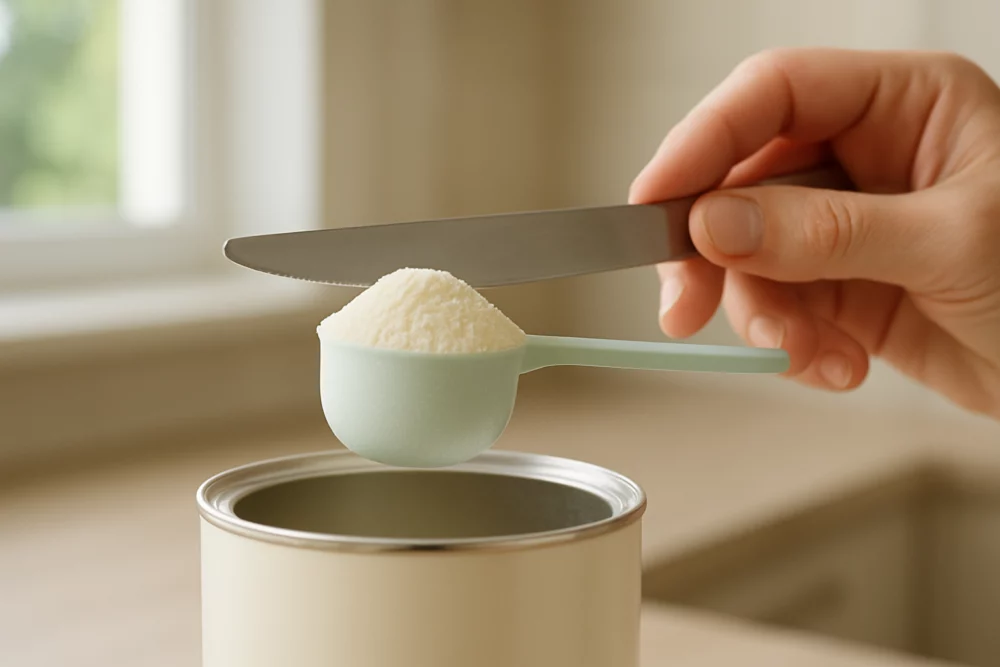
- Heaped or half scoops: “A bit more” or “nearly full” changes the composition. Every scoop is levelled off.
- Not levelled: Use the levelling edge on the tin or the flat side of a clean knife.
- Damp scoop: Residual moisture makes the powder clump and the scoop heavier. Store the scoop dry inside the tin.
Why is it worth checking the tin, even when you know the routine by heart?
Because the preparation table is not the same for every product. Brands such as Holle, HiPP and Kendamil sometimes state different amounts, and things can change between stages within one brand as well.
This matters most when you switch tins or varieties. If you have made up the same formula for months, you carry on automatically with the familiar amount. If you are changing over right now, our article on avoiding mistakes when switching baby formula will help. For European tins with foreign language labelling, you will also find the details on the relevant product page in our range of organic formula milk.
What to do if you lose count
Throw the bottle away and start from scratch. Adding water or powder afterwards rarely gets you back to the right ratio, because you no longer know the starting amount for certain.
That costs formula and patience, especially at night. It is still the more reliable route. If you notice that you often lose count, set out the scoops you need before you start, or make up only one bottle at a time.
When ready to feed formula milk takes the pressure off
Ready to feed formula milk comes pre-mixed in a bottle or carton and needs neither water nor a scoop. When you are out and about, during the night, or for carers who feed only occasionally, it removes one source of error completely.
It is not the right choice for every situation. Compared with powder, ready to feed formula is more demanding to store, opened containers keep for only a short time, and most families still reach for powder to cover feeding at home. As a supplement for certain moments, it can make daily life noticeably calmer. In our shop you will find it under HiPP ready to feed and Kendamil ready to feed.

How to measure reliably day to day
A fixed order of steps helps more than concentration does. If you follow the same steps in the same sequence every time, you lose count less often.
- Wash your hands and get the bottle and teat ready.
- Pour in the stated amount of water and check the scale at eye level.
- Fill the scoop loosely and level it at the levelling edge without pressing.
- Count the scoops, and count out loud if you are tired.
- Close the bottle, swirl rather than shake hard, and check the temperature on your wrist.
If you are interested in the composition behind the preparation table, our article on nutrients in breast milk and infant formula gives you the background.
The right formula milk for young children
Our premium brands Kendamil, Holle and HiPP make sure that newborns and young children are well supplied at every stage of development. We stock the following five stages:
- Pre: from birth, suitable for supplementary feeding or as the sole source of nutrition.
- Stage 1: from birth, keeps your baby satisfied a little longer than Pre.
- Stage 2: from the 6th month, alongside solid foods.
- Stage 3: from the 10th month.
- Stage 4: from the 12th month, as a toddler milk.
When to speak to your paediatrician
If your baby is regularly unsettled after feeding, if weight gain changes, or if you are unsure whether the amounts your baby drinks are right, this is one for the paediatric practice. The same applies if you have been making up bottles incorrectly for a longer period and you are worried.
Do not change the preparation on your own initiative, for example by deliberately making the feed thinner or denser. Adjustments like that belong in medical hands only.
Good to know
- Order: Measured water first, then the powder, otherwise the fill level will be wrong.
- Scoop: Only the scoop from that particular tin, stored dry and levelled off.
- Label: Read the preparation table again with every new tin and every change of variety.
- Mistakes: Discard incorrectly mixed bottles rather than trying to fix them.
- Ready to feed: An option for travel and night feeds, not a full replacement for powder in daily life.
Talk to your paediatrician
Breastfeeding is the best nutrition for your baby. Infant formula is an alternative when breastfeeding is not possible, or not possible on its own. Before you change your baby’s formula or introduce a specialist formula, please speak to your paediatrician.
This article is for general information and does not replace medical advice.